 Radio News Network Radio News Network
Over 308 lives lost in Khyber-Pakhtunkhwa; authorities warn of dangerous Sutlej overflow with reservoirs nearing full capacity
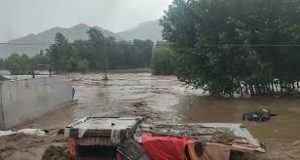
ISLAMABAD – The latest spell of monsoon rains has brought widespread destruction to Khyber-Pakhtunkhwa, where at least 308 people have been killed and 23 others injured in just 48 hours, according to the Provincial Disaster Management Authority. Buner was the worst-hit district, with 184 fatalities, followed by Shangla, Mansehra, Bajaur, Swat, Battagram, Lower Dir and Abbottabad. The deceased included 279 men, 15 women and 13 children. Homes, schools, and bridges have given way as the force of floodwaters swept through valleys, washed away roads, and cut off entire communities from outside help. Official data shows 63 houses completely destroyed and 74 partially damaged, though the real extent of destruction is feared to be far greater as reports continue to pour in from remote areas.
The human tragedy deepened further when a provincial government helicopter carrying relief supplies to Bajaur crashed in Mohmand district amid poor weather, killing all five crew members on board. The government declared a day of mourning, lowering flags to half-mast and pledging full state honours for those who lost their lives in the line of duty. Their deaths highlighted the dangers responders face as they try to rush into inundated areas and pull people to safety.
Rescue operations remain under way across Khyber-Pakhtunkhwa, with the Army, Frontier Corps, and NDMA stepping up efforts. Additional contingents have moved in to reinforce exhausted teams, while helicopters continue to drop food, tents, and medical supplies. Engineers have been ordered to put up temporary bridges and repair damaged ones so communities can reconnect. Specialised dog units and urban search teams are combing through debris to recover survivors and bodies, often working through the night as heavy rain keeps falling. Despite these efforts, reports suggest many people are still trapped, especially in the most battered tehsils of Buner.
The NDMA has dispatched a team to Peshawar on the prime minister’s instructions to oversee coordination, while warning of further landslides in the north. It has advised tourists to stay away from fragile mountainous regions for the next several days. At the same time, All Education Testing and Evaluation Agency examinations scheduled in flood-hit districts have been postponed indefinitely, as students and families struggle to cope with the devastation.
But the danger is not limited to Khyber-Pakhtunkhwa. The Punjab PDMA has issued fresh warnings after rains drenched Murree, Rawalpindi, Sialkot, and Bahawalpur, urging district administrations to stay on high alert. Rivers are filling up fast. The Indus is experiencing low to medium-level flooding at Tarbela, Taunsa, Kalabagh, and Chashma. Tarbela Dam, nearly 98% full, has had its spillways opened to ease pressure, pushing upflows downstream. Mangla stands at about 68%, also leaving a slim buffer margin. The Sutlej has already swelled to a low-level flood at Ganda Singh Wala, raising particular alarm as Indian reservoirs upstream—Bhakra at 61%, Pong at 76% and Thein at 64%—are also filling up. A sudden release could set off dangerous surges, with little time for downstream communities to move out of harm’s way. The Chenab, Ravi and Jhelum remain at normal levels for now but are being closely watched.
This season’s rains have already claimed more than 540 lives nationwide since late June, underscoring how climate change is reshaping monsoon patterns and driving heavier, less predictable downpours. Warmer air is holding more moisture, glaciers in the north are melting earlier and faster, and fragile infrastructure is unable to hold up under the pressure. Pakistan, contributing less than one percent of global greenhouse emissions, finds itself paying the steep price of a crisis it did little to create.
As Khyber-Pakhtunkhwa digs out of debris and Punjab braces for possible flooding, the unfolding crisis drives home a reality the country can no longer put off: unless it strengthens early warning systems, builds resilient infrastructure, and plans ahead for climate-induced extremes, each monsoon season will bring new rounds of tragedy.