 Radio News Network Radio News Network
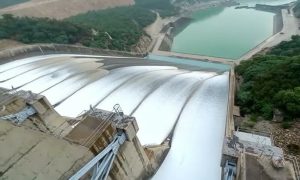
Tarbela’s suspension hinders Pakistan’s 30% renewable target and reservoir evaporation reduction efforts
ISLAMABAD — Pakistan has paused preparations for a 300-megawatt floating solar power project at Tarbela-Ghazi Barotha, which involves $300 million in concessional financing from the World Bank. The Ministry of Energy omitted the initiative from the Indicative Generation Capacity Expansion Plan (IGCEP) for 2025-2035 during a reassessment of future power needs. This step follows the government’s request to the World Bank to halt project development, as confirmed by a Power Division spokesperson in December 2024.
The project, managed by the Water and Power Development Authority (WAPDA), aimed to install two 150-megawatt floating solar plants on reservoirs at the Tarbela Dam and Ghazi Barotha head pond. Feasibility studies began in 2021, with tenders issued in 2023 for design, supply, installation, and commissioning. Bids were invited by March 2024, and the World Bank expressed interest in covering 95% of costs. The setup would connect directly to existing switchyards, avoiding new transmission lines.
The solar facility offered a tariff of 2.98 US cents per unit, lower than rates for about 120 thermal units in Pakistan’s current mix. It projected generation of 484 million units annually, with capital recovery in five years and foreign exchange savings exceeding $72 million per year afterward. Additional benefits included reduced reservoir evaporation amid water scarcity and alignment with Pakistan’s renewable targets: 20% by 2025 and 30% by 2030 under the Alternative and Renewable Energy Policy 2019.
The World Bank supports Pakistan’s shift to renewables and views the pause as temporary. A spokesperson noted that projects can resume quickly if priorities change and formalities complete. As of September 2025, no resumption has occurred, though the lender remains engaged on energy transition efforts. This move reflects ongoing reviews in the sector, where solar capacity has expanded rapidly—net-metered installations reached 5.3 gigawatts by April 2025, comprising over 25% of total production.
The decision prioritizes broader planning amid challenges like heatwaves and low hydropower output from Tarbela, which operated at 25% capacity during recent shortages. Pakistan’s total installed capacity stands at 46,605 megawatts as of March 2025, with solar driving much of the growth.