 Radio News Network Radio News Network
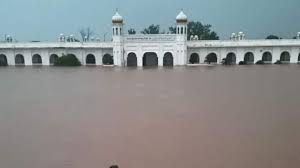
LAHORE: Monsoon floods have unleashed devastation across Punjab, submerging towns, destroying crops, and displacing tens of thousands. According to the National Disaster Management Authority (NDMA), more than 800 people have died nationwide, while over 150,000 residents have been evacuated in Punjab alone as swollen rivers reclaimed their floodplains. Entire districts in south Punjab — once considered the breadbasket of the country — now stand under water, with cotton and rice fields submerged and thousands of livestock lost.
This catastrophe revives memories of the 2022 floods, which affected 33 million people and caused damages estimated at $30–40 billion. For many survivors, today’s tragedy is another reminder that Pakistan has yet to move beyond reactive relief toward resilient adaptation.
Leaders Double Down on Dams
Prime Minister Shehbaz Sharif, after an aerial survey of Narowal, repeated his long-held position that “we must build the capacity for water storage. If there is storage, there will be a shortage of flash floods.” He directed officials to accelerate mega projects like the Diamer-Bhasha and Mohmand Dams, casting them as solutions for flood control, agriculture, and energy security.
Punjab Chief Minister Maryam Nawaz Sharif, visiting Rajanpur, echoed his stance. “We have to save our villages and our children. Mega projects are not a choice, but a necessity,” she said, while announcing compensation of PKR 1 million per victim’s family and promising long-term protection through reservoirs and embankments.
Ecological Science Paints a Different Picture
Experts, however, caution that dams are no silver bullet. “Floods are not walls of water to be stopped at all costs — they are ecological processes,” says Dr. Hassan Abbas, a renowned hydrologist and advocate of free-flowing rivers. He argues that restricting rivers with dams and embankments amplifies disaster by blocking sediment flow, displacing communities, and eroding wetlands.
“Rivers are meant to spill into their floodplains during high flows. That recharge sustains groundwater, revives wetlands, and nourishes the Indus delta,” he explains. “By trying to confine them with concrete, we’ve stripped away natural buffers. The way forward is restoring floodplains, not walling them off.”
Indeed, in Punjab’s Multan and Jalalpur Pirwala, water surged into low-lying colonies built on the rivers’ historical paths. Experts note that urban encroachments into flood channels and loss of wetlands have made damage worse — ironies not lost on a government simultaneously calling for both river clearance and mega construction upstream.
The Green Taxonomy Paradox
Ironically, just last month the federal cabinet approved Pakistan’s first-ever Green Taxonomy — a framework to classify investments into “green,” “amber,” and “red” categories to attract international climate finance. Officials celebrated it as a milestone toward sustainable growth and alignment with donor expectations.
Yet, critics point out the contradiction: while the taxonomy emphasizes nature-based solutions, Pakistan’s leadership is spotlighting dams as flagship “green” projects. “Global climate finance is looking for ecosystem restoration, not concrete mega structures,” Dr. Abbas says. “This mismatch risks undermining Pakistan’s credibility with donors.”
Missing Out on Climate Funds
The funding gap is already glaring. After the 2022 catastrophe, more than $9 billion was pledged for recovery at the Geneva climate conference. By mid-2024, Pakistan had received only $2.8 billion, with later disbursements bringing the total to just $5 billion — far less than half of what was promised. International partners have stressed project alignment with climate resilience principles as a condition for unlocking funds.
Analysts warn that continuing to center adaptation strategies on mega dams — carbon-intensive, ecologically disruptive, and financially burdensome — could leave Pakistan sidelined from the very climate finance it urgently seeks.
The Crossroads Ahead
For now, relief camps in Punjab’s flood-hit districts remain overcrowded, families await food and shelter, and fields that should have yielded autumn harvests lie underwater. The government is debating mega projects, but the science — and the climate finance landscape — points elsewhere.
Pakistan faces a defining choice: whether to cling to concrete as salvation, or embrace ecological resilience through wetlands, floodplains, and delta restoration. As the waters recede, that choice will determine not only how the country weathers future floods but also whether it can access the global climate funds vital to its survival.