 Radio News Network Radio News Network
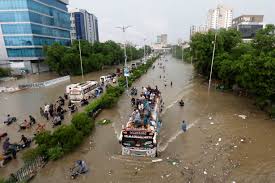
Karachi – Pakistan’s port city and economic lifeline has once again been brought to its knees by the monsoon rains. A brutal cloudburst dumped nearly 170 millimetres of water on the city in just hours, killing eight and leaving neighbourhoods from Gulshan-e-Hadeed to Clifton under water. Major arteries like Shahrah-e- Faisal were swallowed up, flights were held back, and homes were turned inside out as the city of 20 million struggled to get through yet another “rain emergency.”
The storm laid bare decades of neglect. Karachi’s drainage system, built to take on only 40 millimetres of rain, simply gave way. Clogged nullahs, encroachments along the Lyari and Malir rivers, and unchecked concrete sprawl all teamed up to turn streets into canals. Stranded commuters had to wade through waist-deep sewage, while power outages dragged on as Karachi Electric managed to bring up only 1,285 of its 2,100 feeders.
Mayor Murtaza Wahab, under fire for doing too little too late, tried to fend off criticism by pointing to climate change as a global reality. “When rainfall crosses 40 mm, consequences are inevitable,” he admitted. But residents quickly shot back, saying 15 years of PPP rule had done nothing to shore up basic infrastructure.
The Sindh government scrambled to put out fires—closing schools and offices, rolling out suction pumps, and clearing up 44 nullahs. Chief Minister Murad Ali Shah ordered round-the-clock drainage checks, while Rescue 1122 teams pulled out stranded residents. Governor Kamran Tessori rang up Islamabad for help, saying local resources had run out. Traffic police, overwhelmed by choked underpasses, kept calling on commuters to stay put and use helpline 1915 for updates.
But public fury is spilling over. Social media lit up with posts mocking the Sindh government’s “washed away” preparedness claims. Unlike in Swat, where four KP officials were immediately stood down after a botched rescue, Karachi saw no heads roll. Shah’s emergency huddle with bureaucrats focused on coordination, but his silence on accountability only fanned distrust.
What really weighs Karachi down is not just one heavy downpour but years of mismanagement that piled up. Encroachments cut off natural waterways, drains got blocked with trash, and zoning laws were simply brushed aside. The catastrophic floods of 2022—which swept away 1,739 lives across Pakistan—were supposed to push reforms forward, yet projects like Recharge Pakistan’s wetland restoration still haven’t gotten off the ground.
With the Meteorological Department warning that more rains will set in until August 22, the city faces a double blow: immediate health risks like typhoid and mounting economic losses. Already, businesses are tallying up damages while daily wagers watch their livelihoods slip away.
Karachi cannot keep patching up its wounds every monsoon. The city needs to break out of this cycle by overhauling its drainage, cracking down on illegal construction, and drawing up climate-resilient plans before the next deluge strikes. Unless its governance system wakes up and takes ownership, Pakistan’s largest city will keep going under—year after year, storm after storm.