 Radio News Network Radio News Network
85% Chinese financing for Karakoram realignment, multilateral backing for ML-1, and fresh export push mark a strategic reset
Islamabad — After years of delays and debt anxieties, Pakistan and China have unveiled a new phase of their landmark connectivity initiative — dubbed by officials as CPEC 2.0 — with a sharper focus on sustainable financing, climate resilience, and trade-driven growth.
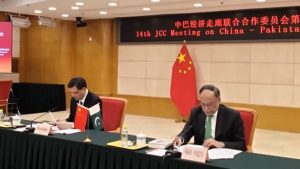
The 14th Joint Cooperation Committee (JCC) meeting, co-chaired in Beijing by China’s National Development and Reform Commission (NDRC) Vice Chairman Zhou Haibing and Pakistan’s Planning Minister Ahsan Iqbal, marked a decisive turn in how the two countries approach the China-Pakistan Economic Corridor.
China, despite concerns over Pakistan’s swelling debt, has agreed to provide 85 percent financing for the realignment of the Karakoram Highway (KKH). The concession was described as a “special case” to safeguard the vital road artery that has become symbolic of China-Pakistan friendship. The realignment is needed after parts of the existing route were swallowed by the Diamer-Basha dam reservoir.
“Connectivity cannot be compromised,” Iqbal said after the meeting. “This project ensures uninterrupted movement between our nations under extreme weather and hydrological changes.”
The $2 billion Thakot-Raikot section has been cleared, with the first 82 kilometers set for reconstruction. Beijing has advised Islamabad not to store water in the dam until the new road is operational — underscoring the delicate balance between Pakistan’s energy ambitions and its transit commitments.
Where the past CPEC phase was powered by concessional Chinese loans, CPEC 2.0 shifts gears toward multilateral financing. The $7 billion Main Line-1 (ML-1) railway upgrade will now be financed by the Asian Development Bank (ADB) and the Asian Infrastructure Investment Bank (AIIB), after Beijing decided against a $6 billion loan.
“The urgency for ML-1 remains,” Iqbal insisted. “We are moving in phases, beginning with Karachi-Hyderabad, to guarantee safety and accelerate progress.”
This pivot reflects Beijing’s quiet but persistent message: Pakistan must restructure its finances before taking on fresh liabilities. Public debt already exceeds 70 percent of GDP. Draft JCC minutes — not yet finalized — reportedly advised Islamabad to “comprehensively” tackle existing debt while finding innovative, non-sovereign financing models for future projects.
Yet CPEC 2.0 is not just about roads and rails. Both sides agreed to formulate a climate resilience and preparedness plan, signalling that infrastructure must adapt to Pakistan’s climate shocks. Gwadar Port will see renewed focus, while trade has been placed at the heart of the next phase.
China has agreed to revisit the Free Trade Agreement, potentially granting Pakistan tariff concessions on par with ASEAN nations. With China importing over $2 trillion worth of goods annually — and Pakistan exporting just $3 billion — the gap offers both a challenge and an opportunity.
Iqbal also proposed the creation of two special economic zones (SEZs) in Karachi and Islamabad, designed as government-to-government model hubs for Chinese firms relocating in textiles, electronics, engineering, and electric vehicles. To reassure investors, Pakistan pitched a dedicated Industrial Relocation Fund with Chinese partnership.
For Islamabad, this shift marks more than just economics. With geopolitical rivalries heating up and narratives around CPEC facing criticism, Iqbal stressed that the JCC’s conclusions must remain “conclusive, decisive, and result-oriented” to counter what he called “negative propaganda.”
If the first phase of CPEC was about roads, power plants, and ports, the second phase is shaping up to be about discipline, diversification, and debt-conscious growth. Both partners know that how CPEC 2.0 unfolds will not just test Pakistan’s ability to reform its economy — it will also determine the corridor’s credibility as a model for regional integration.