 Radio News Network Radio News Network
Islamabad lost 14 hectares of tree cover from 2001 to 2024 (0.45% of its 2000 baseline) and another 14 hectares from 2021 to 2024
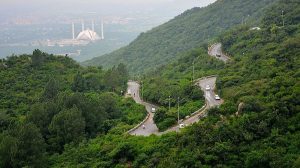
ISLAMABAD: Rampant tree cutting, unchecked urban expansion, and cosmetic plantation drives have pushed Islamabad and Rawalpindi into the upper echelons of Pakistan’s most polluted cities, with Islamabad ranking second nationally in 2025 air quality indices behind only Murree. Globally, the capital placed fifth among the world’s most polluted capitals in 2024, according to IQAir’s World Air Quality Report. A special report on environmental degradation in the twin cities reveals that large-scale deforestation along the Metro route—where over 1,500 mature trees were felled between 2014 and 2018—and recurring forest fires in the Margalla Hills have inflicted severe ecological damage, contributing to Pakistan’s third-place ranking as the world’s most polluted country last year.
Once celebrated as “Islamabad the Beautiful,” the capital’s charm is fading fast. While new roads and metro lines have expanded, its greenery has steadily disappeared: between 2001 and 2024, the city lost 14 hectares of tree cover, equivalent to 0.45% of its 2000 baseline, and a further 14 hectares from 2021 to 2024 alone—nearly half a percent of its canopy. The report points to repeated fires in the Margalla Hills, which scorched 267 acres over the past three years, and widespread tree loss, devastating the city’s natural landscape. Nationally, Pakistan’s forest cover has plummeted 18% over the last 33 years, from 3.78 million hectares in 1992 to 3.09 million in 2025, with the country losing 11,000 hectares annually and holding just 5% forest cover overall.
According to findings, the Capital Development Authority (CDA) has prioritized expensive, non-native species for plantation drives—many of which fail to adapt to local conditions, with survival rates often dipping below expectations despite claims of over 90% in select trials. Each year, thousands of saplings are planted, but few survive, resulting in environmental loss and wasteful expenditure. The CDA’s Spring Tree Plantation Drive 2025, launched in February, targeted extensive planting in F-9 Park and other areas, yet lacks independent audits to verify long-term viability. Meanwhile, the Rawalpindi Development Authority (RDA) and Parks and Horticulture Authority (PHA) spend lavishly on beautifying VIP routes while neglecting other neighbourhoods.
Much of Islamabad’s green belts have been encroached upon by police departments and five-star hotels, which have converted open areas into offices and parking lots. Once lush and vibrant, these spaces are now symbols of civic negligence and urban decay. Over 2000–2020, the city lost 36% of its urban green spaces and 10% of water bodies, per NUST research, exacerbating heat islands and pollution.
In the past three years alone, 146 forest fires in the Margalla Hills have destroyed nearly 3,000 trees, scorching 267 acres in total—with 26 incidents in 2022 damaging 117 acres. Thousands more were felled for the Metro route—without any official record, including 600 mature trees and 4,000 shrubs during the 2017 phase. The CDA, tasked with environmental protection, has no reliable data on tree cover, while 803 acres of forest land and 122 kanals of green space have been lost to encroachments and illegal constructions.
Even Islamabad’s Traffic Police have set up offices on green belts, while several major hotels have turned public land into private parking areas. The report also highlights poor hospital waste management—where incineration releases heavy metals into the air and soil—and the spread of slums across parks, drains, and open green zones, with 63 such underserved settlements now dotting 20 of the city’s 26 union councils.
Environmentalists hold the CDA responsible for Islamabad’s growing pollution and vanishing tree cover. They warn that unchecked development and weak governance are stripping the city of its natural identity, mirroring national trends where forest loss fuels flood risks and climate vulnerability—Pakistan ranked first in the 2025 Germanwatch Climate Risk Index.
In response, a CDA spokesperson claimed that each year, around 200,000 trees, 1.6 million grafted plants, and 500,000 seed balls are planted across Islamabad—a claim experts say must be backed by survival audits, not press releases. The authority’s ongoing beautification reviews emphasize indigenous species, but implementation remains spotty.
As Islamabad expands outward—the Green Pakistan Programme achieving just 68% of its 2025 tree-planting targets nationally—the question remains: can the capital reclaim its green soul before it’s too late?