 Radio News Network Radio News Network
River diversion, land erosion, and deadly sand mounds expose the human cost of a billion-rupee industry
Mining Boom Tears through Ecology and Livelihoods
Farmers lose land, fish vanish, and tourists perish as Swat’s riverbed is carved away
SAIDU SHARIF, July 10 – Once the beating heart of Khyber Pakhtunkhwa’s scenic valleys, the Swat River is now caving in under the relentless pressure of unchecked gravel and sand mining. What started off as a small-scale operation has blown up into a billion-rupee business, leaving behind a trail of ecological devastation and human loss.
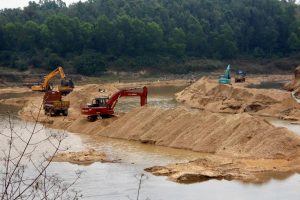
Stretching 240 kilometers from Kalam to Kanju, the river now plays host to more than 350 stone-crushing plants. During the dry winter months—when water levels drop—heavy machinery moves in, tearing through the riverbed. Trenches as deep as 30 feet and 15 feet wide are dug out, often well beyond the legal 3-meter limit. To make extraction easier, the river is diverted, and its flow tampered with. A truckload of sand can fetch up to Rs7,000, while gravel sells for Rs3,000, making the trade hard to turn down.
But the profits come at a steep cost. Data from the Khyber Pakhtunkhwa Minerals Department shows that while mining leases are granted under the 2022 River Bed Mining Rules, oversight has largely fallen through the cracks. Inspections are rare, and even when violations come to light, enforcement remains weak or symbolic. A 2025 study in Natural Hazards and Earth System Sciences warns that sediment removal has overshot sustainable levels, weakening riverbanks and putting nearby villages in the path of future floods.
Environmental damage is mounting fast. Satellite images and GIS data, published in Frontiers in Environmental Science this year, show the river veering off course at multiple spots. Land that once supported thriving farms has dried up or been swallowed by seasonal floods. Tree cover that used to hold the banks in place has been cleared out to make room for excavators and access roads, speeding up erosion.
The river’s ecosystem is falling apart. The native Swat trout, once abundant in these icy waters, has all but vanished. Fishermen say their nets come up empty more often than not, forcing many to walk away from their trade. Recent biodiversity surveys by the KP Environmental Protection Agency show a sharp decline in macroinvertebrates—tiny water organisms that signal healthy water quality—especially in the lower reaches of the river.
The crisis hit a tragic note in June 2025, when 13 tourists lost their lives near Bahrain. They had pitched tents on a sandbank formed by excessive mining. When upstream water was suddenly released, the bank gave way, sweeping the entire group downstream. The accident sparked a public outcry and led to a short-lived ban on mining in parts of the district. But the pause didn’t last. Within weeks, extraction quietly picked back up, exposing how hard it is to clamp down on violations amid rising demand for construction material.
With urban construction in full swing in Mingora, Peshawar, and beyond, the pull of profits remains strong. Mining syndicates—some allegedly linked to political patrons—continue to skirt the law. Rules meant to safeguard the river are brushed aside in the rush to cash in.
Experts are sounding the alarm. A 2025 LSTM-model-based projection warns that if current rates of extraction carry on unchecked, the Swat River will face a severe sediment imbalance within five years. The consequences could be devastating: flash floods, collapsing riverbanks, and irreversible ecological collapse.
Unless authorities step in with real-time monitoring, tough penalties, and aggressive reforestation, the river may not bounce back. For a region that once drew life, identity, and livelihood from its waters, the cost of letting things slide could be catastrophic.